Special Vibrators
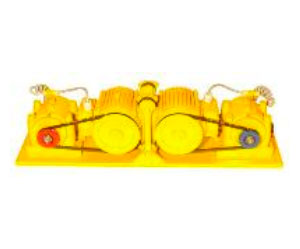
Tornado vibrator
This vibrator was designed for the mould vibration of mobile block making machines. Due to the use of two different v-belt pulleys on the vibrating elements two different vibration frequencies are being generated. This way the unwished synchronisation of the the two vibrating element, at what the generated force are almost neutralized, is being avoided.
| Centrifugal force: | 2.500 - 20.000 N |
| RPM | 6.850 - 7.010 1/min |
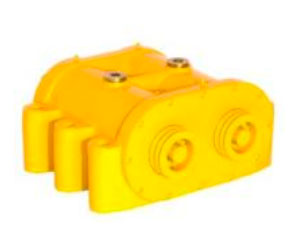
Jumbo vibrator
his vibrator was designed for the use in stationary block making machines. The compact design allows to achieve very high forces and therefore acceleration in limited space. Also the design of the vibrating table is easier and weight saving. The mechanical synchronisation within the vibrator guarantees an always linear force output.
| Centrifugal force | 27.000 - 100.000 N |
| RPM | 3.800 - 5.100 1/min |
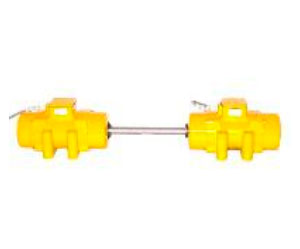
Coupling of vibrators
It in not always useful to generate the needed force, for e.g. a linear acting vibrating table, with only two vibrators. Especially for larger vibrating table it is often useful to induce the force evenly over the area of the table. This can be easily achieved with coupled vibrators. Often weight can also be saved at the same time, because several small vibrators mostly weigh less than two big vibrators with the same force. Hereby the total needed forces decrease, because only the reduced total weight of the table has to be vibrated.
| Centrifugal force | 6.000 - 600.000 N |
| RPM | 1.000 - 6.000 1/min |
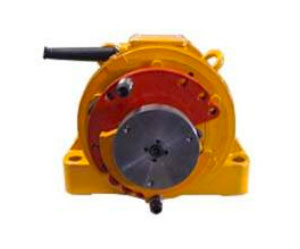
Turnover unbalances
Some production processes require high forces for the compaction of the mixture, but afterwards much lower forces for the deaeration. Both necessary settings often can not be realised just by changing the rpm's. Turnover unbalances allow to have two different unbalances on vibrator at disposal, just by changing the direction of rotation. Due to the fact that the unbalances for both directions are also adjustable, settings for all different processes requirements can be found.
| Centrifugal force | 10.000 - 50.000 N |
| RPM | 1.000 - 6.000 1/min |
Application in various industries
- Construction industry
- Industry of building materials
- Mining industry
- Chemical industry
- Packaging and food industry
- Mechanical engineering
- Quality inspection and quality assurance

Contact Person
In terms of questions in the area of "external vibrators" please contact:
Dominik Rensch
08171 - 6295-40
E-Mail
Frequently asked questions about special vibrators
FAQ
What are special vibrators?
Special vibrators are specially developed external vibrators for individual and particularly demanding applications. They are used wherever standard vibrators no longer meet the required performance, the desired force curve or the intended installation conditions. The design and layout are application-specific, for example with defined linear force curves, variably adjustable imbalance sizes or specified vibration frequencies, right through to multi-frequency operation. This allows the direction of vibration, acceleration and force distribution to be precisely matched to the respective product and the machine used.
What is the difference between Tornado and Jumbo vibrators?
Tornado vibrators are designed for mould vibration in mobile block making machines. Two V-belt pulleys of different sizes on the vibrating elements generate two different vibration frequencies. This prevents unwanted synchronisation of the two vibrating elements, which would almost cancel out the forces generated by each (idling).
Jumbo vibrators are specially designed for stationary block moulding machines. Thanks to their compact design, very high forces and correspondingly high acceleration values can be achieved even in confined installation spaces. At the same time, the design of the vibrating tables is simpler and more weight-saving. The mechanical synchronisation in the vibrator ensures that the force output is always purely linear. The difference between the two types of vibrators therefore lies primarily in their area of application, design and type of force transmission.
Why can coupling vibrators be useful?
It does not always make sense to generate the required force in linear vibrating tables with just a few large vibrators. Especially with larger tables, it is often advantageous to apply the vibrating forces evenly across the entire surface, which can be achieved very well with coupled vibrators. Several smaller units can often save weight, as they usually weigh less together than two large vibrators with comparable total power. The lower system weight that needs to be vibrated in turn reduces the total force required and supports energy-efficient operation of the vibrating table.
For which areas of application/industries are special vibrators typically relevant?
Special vibrators are mainly found in the construction and concrete industries, where moulded parts need to be compacted and surface qualities need to be reproducible. Other typical areas of application are in mining and the chemical industry, for example in the compaction, conveying or classification of bulk materials. In the packaging and food industries, they are used to position products, minimise cavities or achieve uniform filling levels. Application-specific vibrators are also used in mechanical engineering and in testing and inspection technology when components need to be exposed to defined vibration loads or processes need to be stimulated in a reproducible manner.
What are swing pieces – and what problem do they solve?
Some manufacturing processes initially require high vibration forces for intensive compaction of the mixture, but subsequently require significantly lower forces for gentle deaeration. These two operating states cannot always be achieved reliably by changing the speed alone. Reversible flyweights offer a solution here by providing two different imbalance sizes on a vibrator, depending on the direction of rotation. Since the imbalance can be adjusted additionally for each direction of rotation, the vibration forces can be precisely adapted to the respective process requirements and the compaction and deaeration phases can be optimally coordinated.
Other products
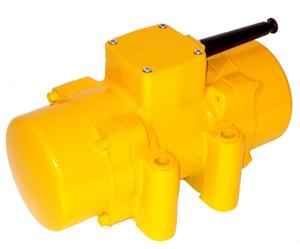
External Vibrator Series R
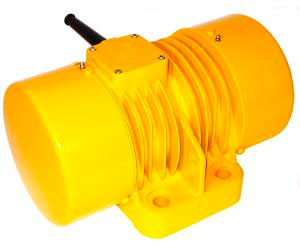
External Vibrator Series V
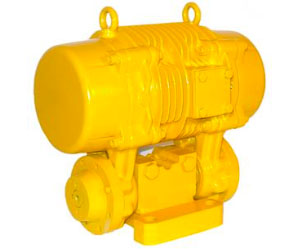
External Vibrator Series A
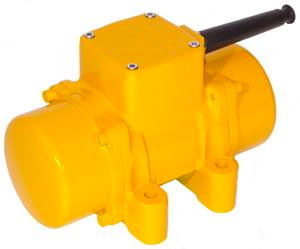
External Vibrator Series R-HF