Vibrating Tables for Mineral Cast
Vibrating table for the produktion of prefabricated mineral cast
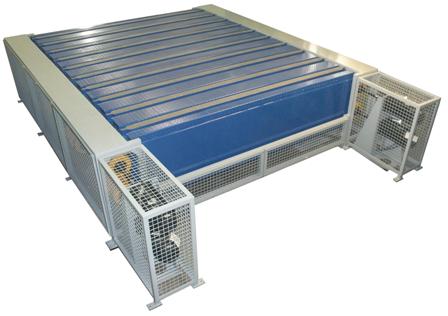
Vibrating table for the produktion of prefabricated mineral cast
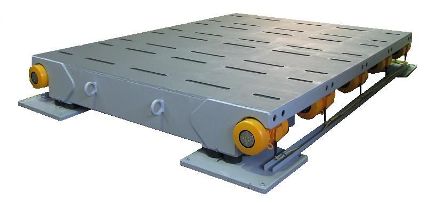
Vibrating table for the produktion of prefabricated mineral cast
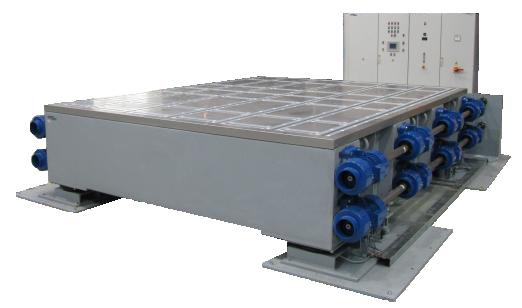
Vibrating table for the produktion of prefabricated mineral cast
This plant has been developed for the company EPUCRET for the production of machine frames out of mineral casting. EPUCRET has been active for over 20 years at the cutting edge of polymer-bonded mineral casting technology and offers its customers from the mechanical, plant and appliance engineering industries a competent all-round service for system solutions using mineral castings. (for further information see www.epucret.de).
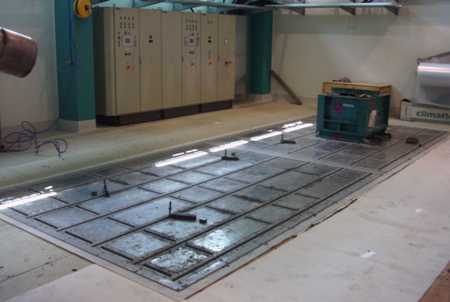
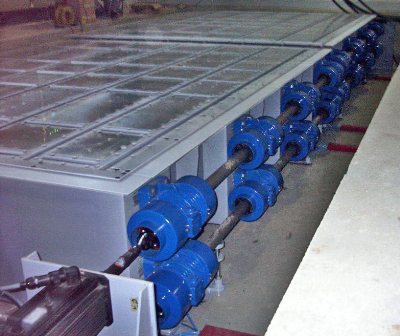
During the development of the machine it had to be considered that the production program reaches from small over medium sized to large products und that these had to be produced efficiently on this plant. The plant consists of 2 vibrating table which are suspended by air springs and which can be run simultaneously or independently. The working level is being kept constant by a level control. During the production of small and medium sized products this design allows to produce 2 parts at a time with different vibration settings. When a large product has to be produced, the vibrating tables get connected electrically in a way, that the level control and the vibration run absolutely synchronous.
| Technische Daten: | Vibrating table | Total system |
| Width: | 3100 mm | 3100 mm |
| Length: | 3900 mm | 7800 mm |
| Max. payload: | 15.000 kg | 30.000 kg |
| Frequency range: | 10 - 80 Hz | 10 - 80 Hz |
| Displacement: | 0 - 0,25 mm | 0 - 0,25 mm |
| Unbalance: | 0 - 19 Nm | 0 - 38 Nm |
The vibration of the tables is being generated by external powered vibration elements. Each table is being powered by 4 asynchronous servo motors, which each drives 4 vibrating elements.
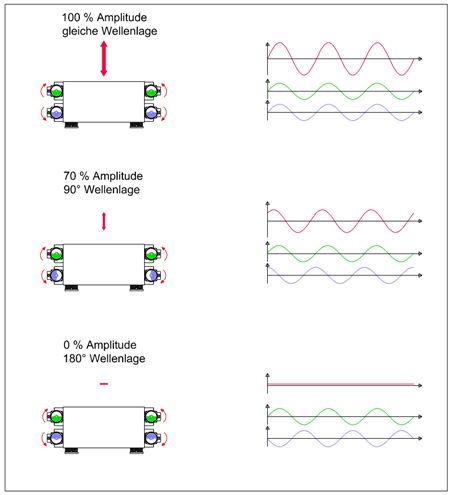
The use of asynchronous servo motors allows changing the position of the driven unbalances on the shafts towards each other. In this system each 2 shafts are a pair and the shafts are counterrotating, but synchronous. If now the position of the 2nd pair gets changed towards the position of the 1st pair in the range of 0 to 180°, the amplitude will change between 0 and 100%. Due to the fact that 4 shafts are needed for such system, it is called 4-shaft-technique.
During the filling of the moulds the weight on the vibrating table increases and the level of the table decreases. This will be corrected from the level control automatically by increasing the pressure in the air springs. The level control is very important during the production of large work pieces, because the 2 tables are not mechanically connected, but the levels of both tables have to be the same at all times. To achieve this difficult requirement retroreflective sensors with a small hysteresis are being installed on all 4 corners of the tables.

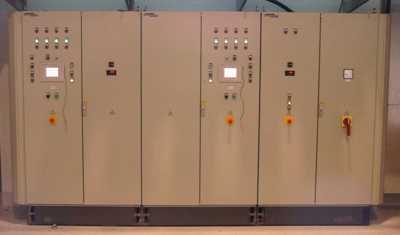
The equipment can be operated from a central switch cabinet. The cabinet contains the PLC, which on one side enables the automation of the production process and on the other side controls the total system with its components and displays the detailed reason of occurring problems on the screens. On top of that the manufacturer of the equipment can support the troubleshooting with a remote maintenance system.
Each of the tables has a complete set of controls, including touch screen. With a turn of a key switch the table can be connected and the system can be operated from either set of controls. Also the actual acceleration of each table can be read from additional displays at all time.

Contact person
For questions about the product range "Vibrating tables", please contact
Peter Ortmann
08171 - 6295-24
E-Mail
Frequently asked questions about vibrating tables (Mineral Cast)
Frequently asked questions
What are mineral casting vibrating tables used for?
These specialised vibrating tables have been specifically developed to meet the high demands of manufacturing components from mineral casting / polymer concrete. Their primary application lies in the production of large-format and solid workpieces, such as precision machine bases, beds for machine tools or frames for the semiconductor industry. During the casting process, the tables perform a crucial function. Targeted vibration ensures that the viscous material is optimally compacted and trapped air is effectively removed from the casting mixture. This is the fundamental prerequisite for a homogeneous, void-free structure and an excellent surface finish.
How large and powerful are mineral casting vibrating tables?
The dimensions of these systems are based on industrial standards. A typical example of large-scale applications is a table size of approximately 4 m × 3 m, which can easily accommodate the heaviest workpieces, such as machine bases for milling machines or lathes. To achieve the required acceleration values even under extremely high loads – often in the range of several tonnes – the systems are equipped with a large number of powerful vibrators. Depending on the model, mineral cast vibrating tables achieve vibration frequencies of 30 to 80 hertz and centrifugal forces of up to 440 kN. This enormous performance capability makes it possible to activate centrifugal force in a targeted manner and distribute the vibration evenly across the entire table surface. This guarantees reliable compaction even with the most massive components.
How do mineral casting vibrating tables adapt to different workpieces?
A major advantage of these systems lies in their adaptability. Moulds can be positioned and secured using adjustable clamps, which makes handling different geometries significantly easier. Furthermore, the vibration settings are adjusted via an intelligent control system. Both the vibration frequency and the amplitude can be precisely adjusted to the respective material and the specific geometry of the component. This means that the same vibrating table can be used effectively for small, medium or very large workpieces. In multi-unit systems, it is even possible to operate individual tables separately or in tandem to work in parallel with different vibration conditions.
What are the distinctive features of mineral cast vibrating tables?
The most notable feature is the high efficiency of the mechanical vibration. In models specifically designed for mineral cast, the vibrational force is transmitted linearly and exclusively vertically into the system, which facilitates particularly targeted compaction. Many systems also feature freely selectable frequencies, adjustable stroke lengths and sophisticated clamping systems for mould mounting. The result is precise, reproducible production that is also suitable for heavy and complex components.
Vibrating tables
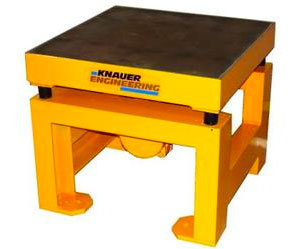
Vibrating Tables Standard
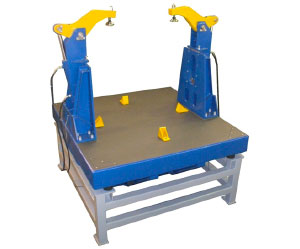
Custom-built Vibrating Tables
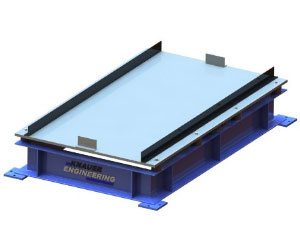
Vibrating Tables for Gabions
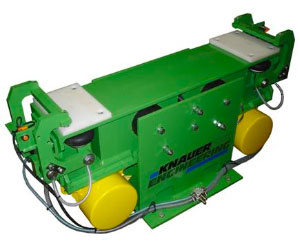
Vibration Stands
Vibrating Sieves
Big Bag Compacter