Vibration Stands
Vibration Stands for the Manufacturing of big Concrete Parts
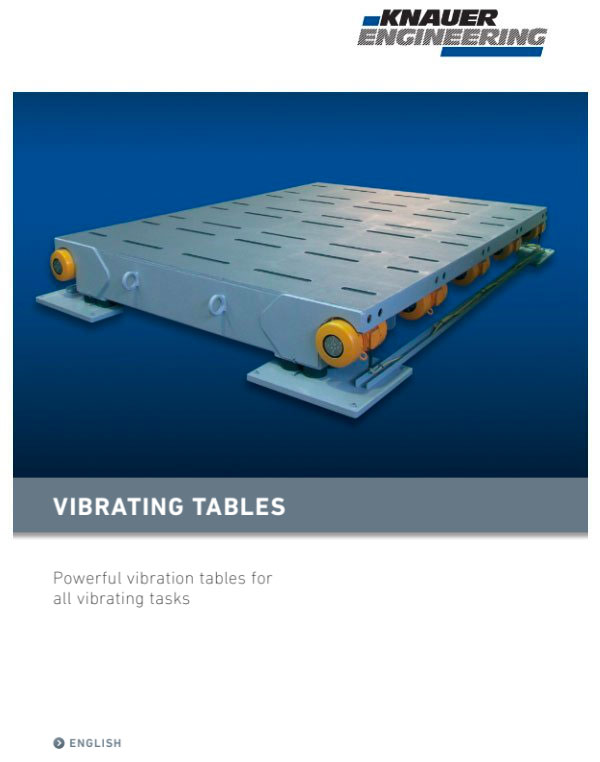
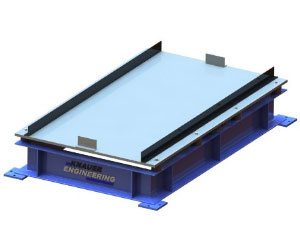
Knauer Engineering vibrating stands for the production of large concrete elements, in clamped or free riding moulds, are specially made according to product and customer requirements.
Special features:
- The vibrating frequency can be freely selected during the compacting process.
- Two different displacements/ forces possible, by just switching the rotation of the motors.
Areas of application
- Construction industry
- Concrete industry
- Mining
- Chemical industry
- Packaging and food industry
- Mechanical engineering
- Inspection and test technology

Contact person
For questions about the product range "Vibrating tables", please contact
Peter Ortmann
08171 - 6295-24
E-Mail
Frequently asked questions about vibrating blocks
Frequently asked questions
What are vibrating blocks?
Vibrating blocks are vibration and compaction modules. These production systems enable a company to compact concrete and other materials into moulds. There are various types of vibrating blocks. These systems are often manufactured as individual vibrating beams. In addition, there are complete vibrating stations consisting of two or more vibrating blocks with a vibrator on each side. As a rule, these production systems are designed to enable industry to manufacture heavy and large components. Consequently, the production of railway sleepers, for example, is a typical area of application in which vibrating stations are frequently used.
Can moulds or workpieces be secured?
To secure moulds or workpieces, any vibrating table can be fitted with a suitable fixture. This helps to avoid unnecessary problems during manufacturing processes. Suitable fixtures secure the vibrating tables and prevent workpieces or moulds from slipping whilst the production equipment is in use. In many cases, hydraulic clamps are used for this purpose. Such devices reliably ensure that the respective objects are firmly secured. Companies thus benefit from significant advantages whilst using a vibrating beam or a vibrating station. Securing workpieces and moulds with high-quality devices generally increases process reliability and has a positive effect on reproducibility.
What applications are vibrating blocks suitable for?
Thanks to their ability to compact concrete, modern vibrating blocks are primarily suited to the production of large concrete elements. These include, for example, sleepers, which play a significant role in the railway industry, particularly as track supports. Furthermore, noise barriers are a typical concrete element that can be produced using vibrating stations. Accordingly, the vibration modules are responsible for important tasks in both the construction industry and the concrete industry. However, there are also other industries in which these production systems serve a purpose. Whenever there is a need for the efficient compaction of large volumes, vibrating beams can be extremely helpful in any sector.
What advantages do vibrating blocks offer over conventional vibrating tables?
Compared to conventional vibrating tables, the flexibility to combine units is a key advantage of vibrating blocks. A notable feature is that these production systems can be used as individual vibrating beams for smaller projects and as interconnected stations for larger challenges. Furthermore, companies benefit from the fact that these systems are particularly well-suited to long and heavy moulds. As the frequencies and forces are adjustable, vibrating blocks offer a further decisive advantage over conventional product solutions. This enables process-oriented adaptation, allowing for customised use across a wide range of tasks.
Further products
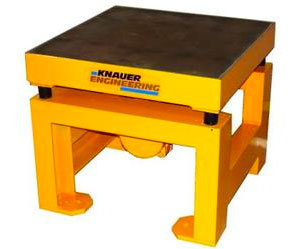
Vibrating Tables Standard
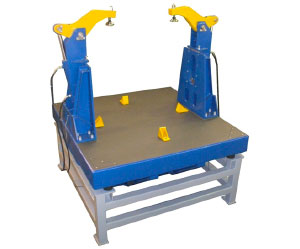
Custom-built Vibrating Tables
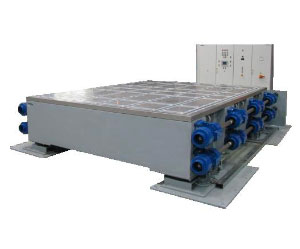
Vibrating Tables for Mineral Cast
Vibrating Tables for Gabions
Vibrating Sieves
Big Bag Compacter